- Housing is the biggest cost variable — Myrtle Beach offers meaningful savings over most northeastern, midwestern, and Florida coastal markets at comparable property types.
- South Carolina's homestead exemption reduces property tax assessments on primary residences from 6% to 4% of fair market value — a significant annual savings over comparable states.
- Flood insurance is the most unpredictable line item: costs vary dramatically by flood zone and can range from $500 to $5,000+ annually depending on the property's location and elevation.
- South Carolina has no estate or inheritance tax, making it particularly favorable for retirees and estate-planning buyers.
- Overall cost of living in Myrtle Beach is generally 15–25% lower than comparable Florida coastal markets and 20–35% lower than comparable northeastern coastal areas.
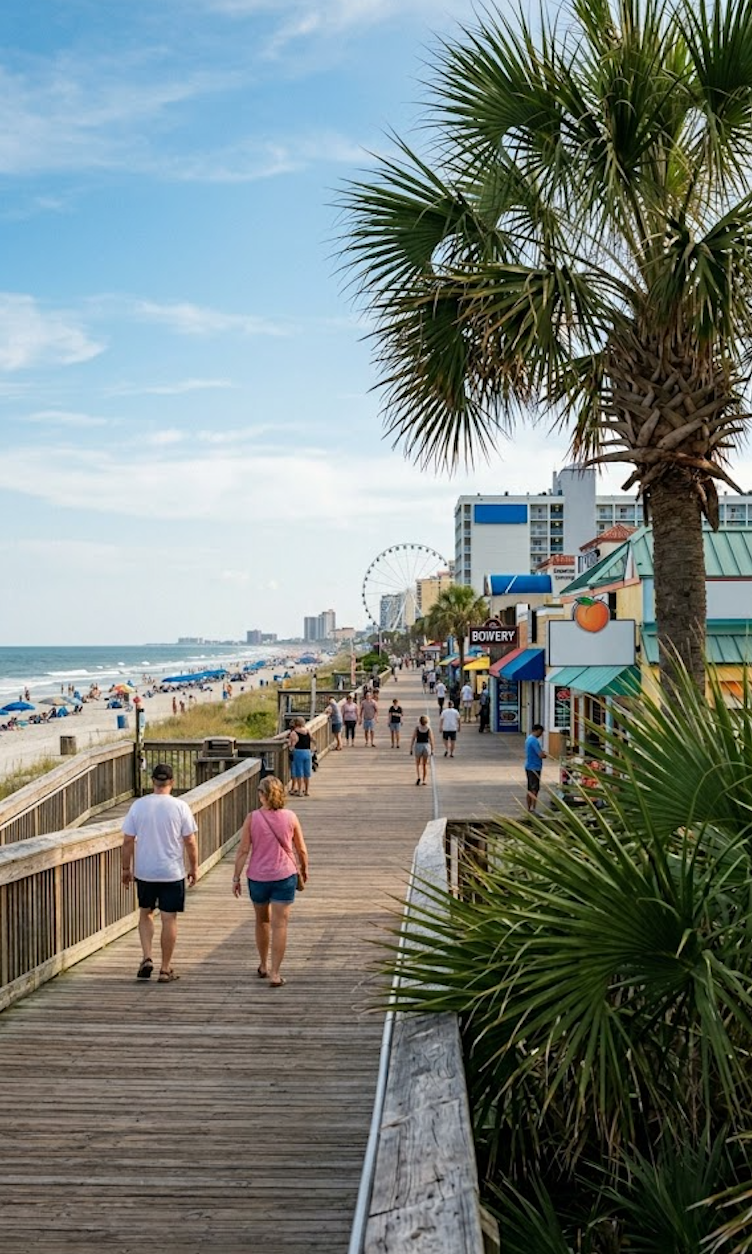 For buyers comparing Myrtle Beach to other coastal markets, the cost of living conversation usually starts with housing — and it should. But a complete financial picture includes property taxes, insurance, HOA fees, utilities, and the broader South Carolina tax environment. Here's the full breakdown.
Housing Costs — The Biggest Variable
Housing is where the Grand Strand delivers its most significant cost advantage over competing coastal markets. Median single-family home prices in the Myrtle Beach metro area range from the low-$300,000s in inland communities like Socastee or parts of Conway, to the mid-$400,000s in well-established neighborhoods like Carolina Forest, to $600,000+ for premier addresses in Grande Dunes, oceanfront condos, or Pawleys Island. This range sits well below comparable-quality housing in Florida's Gulf Coast markets, the Carolinas' Triangle, or virtually any northeastern coastal community.
Rental prices follow a similar pattern. A two-bedroom apartment in the Myrtle Beach area averages $1,400 to $1,900 per month, significantly below rates in Raleigh, Charlotte, or comparable Florida markets. See the Myrtle Beach real estate market report for current pricing data across property types and neighborhoods.
Property Taxes in South Carolina
South Carolina's property tax structure is one of its most buyer-friendly features, particularly for primary residents. All properties are assessed at a percentage of fair market value, and that rate differs meaningfully based on how you use the property:
Owner-occupied primary residences: assessed at 4% of fair market value. Investment or vacation properties, non-primary residences: assessed at 6% of fair market value. The millage rate — the rate per $1,000 of assessed value — varies by location within Horry County and the specific municipality, but the net effect is that a primary resident in Myrtle Beach pays significantly less in annual property taxes than the owner of a comparable-value property used as a vacation home or rental.
To claim the 4% rate, you must file a legal residence exemption application with the Horry County Assessor's office after closing. This is not automatic — you must apply. For most primary residents, this step results in hundreds to thousands of dollars in annual property tax savings.
Homeowner's and Flood Insurance
This is the cost category that surprises most relocating buyers, particularly those coming from inland markets. Coastal properties in South Carolina face elevated insurance costs driven by hurricane risk, wind exposure, and in some areas, flood zones.
Standard homeowner's insurance (wind/hail included) for a single-family home in the Myrtle Beach area typically runs $2,000 to $5,000 annually, depending on construction type, age of the home, and distance from the coast. Newer construction with wind mitigation features can be at the lower end of this range.
Flood insurance is a separate policy from homeowner's insurance and is required by lenders for any property in a designated high-risk flood zone. Costs range from approximately $500 to $1,500 annually for lower-risk zones (AE with favorable base flood elevation) to $3,000 to $6,000+ for properties in high-risk VE zones (coastal high-hazard areas). Before making an offer on any property, your agent should pull the FEMA flood zone designation and you should request an insurance quote for that specific address.
 HOA Fees
HOA fees are a significant ongoing cost for many Grand Strand properties. They vary enormously by community and property type. Condo communities with resort amenities can carry monthly fees of $500 to $1,000 or more.
Single-family home communities with pools and common areas typically range from $100 to $400 per month. Some planned communities include cable and internet in the HOA fee; others do not. Always request and review the HOA fee breakdown, the most recent financial statements, and the reserve fund balance before purchasing.
Utilities
Utilities in Myrtle Beach are near national median levels. Electric bills average $100 to $180 per month for a standard home, with higher costs in summer months due to air conditioning demand. Natural gas is less common than in northern markets; many homes rely entirely on electric systems. Water and sewer costs are typically $50 to $90 per month. Internet service options include fiber and cable depending on the neighborhood, with typical plans running $50 to $100 per month.
Groceries, Healthcare, and Transportation
Grocery prices in the Myrtle Beach area are near national averages, with several major grocery chains including Publix, Food Lion, Harris Teeter, Walmart, and Aldi serving the market. Healthcare costs are also near national averages, though availability can be a consideration — the Grand Strand's healthcare infrastructure has grown significantly but can still have wait times for specialists.
Transportation costs depend heavily on lifestyle. The Grand Strand is not walkable in most areas — a car is essentially required for daily life outside of Market Common. Gas prices are typically near the Southeast average. No state income tax on Social Security income makes Myrtle Beach particularly attractive for retirees calculating monthly cash flow.
South Carolina's Broader Tax Advantages
Beyond property taxes, South Carolina offers several tax advantages that matter significantly to the types of buyers who are most active in the Myrtle Beach market. There is no estate or inheritance tax in South Carolina. Social Security income is fully exempt from state income tax. There is a substantial retirement income deduction for residents over 65. The state income tax is structured progressively with rates that compare favorably against high-tax states like New York, California, and New Jersey.
For retirees relocating from high-tax states, these advantages can add up to thousands of dollars annually in reduced tax liability — a meaningful part of the total cost of living comparison.
How Myrtle Beach Compares to Competing Markets
Against Florida Gulf Coast markets (Sarasota, Naples, Fort Myers, Destin): Myrtle Beach is typically 15–30% less expensive for comparable housing. Against the Outer Banks or Hilton Head Island: meaningfully less expensive in most property categories. Against northeastern markets (Delaware, New Jersey, Long Island): 30–50% less expensive for comparable coastal proximity. The combination of lower housing costs, favorable property tax structure, and no estate tax makes Myrtle Beach one of the most cost-efficient coastal markets in the country for primary residents and retirees.
To compare current sold prices across the Grand Strand, view recently closed properties for real transaction data. If you're considering selling a home elsewhere to fund a purchase here, Abe Safa can help you model the full financial comparison. Reach him through the seller resources page or by calling (843) 360-2145.
Frequently Asked Questions
Is Myrtle Beach affordable to live in?
Myrtle Beach is generally considered affordable relative to most coastal U.S. markets. Housing costs — both purchase prices and rent — are lower than comparable markets in Florida, the Carolinas' Triangle, the Northeast, and the Pacific Coast. Groceries, transportation, and healthcare costs are near national median levels. The tax environment is favorable for primary residents, with no estate tax and a homestead exemption that reduces property taxes on owner-occupied homes.
What is the average cost to buy a home in Myrtle Beach?
As of mid-2026, median single-family home prices in the Myrtle Beach metro area range from the low $300,000s in more inland communities to $500,000 and above for oceanfront or premium community properties. Condo prices vary widely by building, location, and size — from under $200,000 for older, smaller units to $600,000 or more for oceanfront units in premium buildings. Prices have shifted with broader national market conditions; check the Myrtle Beach real estate market report for current data.
How much is flood insurance in Myrtle Beach?
Flood insurance costs in Myrtle Beach vary significantly based on the property's FEMA flood zone designation, its elevation, and the building's construction type. Properties in high-risk zones (AE or VE) can pay $2,000 to $5,000 or more annually for flood coverage. Properties in lower-risk zones may pay $500 to $1,500 annually. This cost should be researched for any specific property before making an offer.
What is the property tax rate in Myrtle Beach?
South Carolina's effective property tax rate is among the lowest in the country for primary residents. Owner-occupied homes are assessed at 4% of fair market value, compared to 6% for non-owner-occupied properties. The millage rate varies by location within Horry County but results in effective annual property tax bills that are meaningfully lower than comparable-value properties in northeastern or midwestern states.
How does Myrtle Beach cost of living compare to Florida beach towns?
Myrtle Beach generally offers lower housing costs than comparable Florida beach markets such as Sarasota, Naples, Destin, or Palm Beach. South Carolina also has no estate tax, and SC's homestead exemption for primary residents provides a meaningful property tax advantage. Overall, Myrtle Beach is typically 15–30% less expensive for housing than most Florida Gulf Coast markets at comparable property types.